Iliana Pagán-Teitelbaum
- Professor of Languages
- Ph.D., Harvard University
- M.A., Harvard University
- M.A., University of Salamanca
- B.A., University of Puerto Rico
- IPagan@wcupa.edu
- Mitchell Hall 127
- 610-436-3216
Dr. Pagán
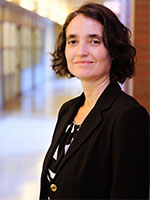
Dr. Iliana Pagán-Teitelbaum (she/ella) is a Professor of Languages and Cultures at West Chester University of Pennsylvania. She obtained a BA in Latin American Studies at the University of Puerto Rico. She has MA and PhD degrees in Romance Languages and Literatures from Harvard University and was a Mellon Postdoctoral Fellow at the University of Pennsylvania. She was also awarded a MA in Creative Writing in Spanish at the University of Salamanca, Spain.
Dr. Pagán teaches courses on Latin American film and global cultural studies. Her research focuses equity and violence in Latin American culture. In the past, Dr. Pagán has been Faculty Advisor for the Latino American Student Organization-LASO and has chaired the WCU Innovation in Diversity and Inclusion Grants Council. She has directed the WCU Global Hispanic Film Festival since 2015.
Research Interests
- Equity and Violence
- Critical Discourse Studies
- Contemporary Latin American Film and Literature
- Latin American Studies
- Cinema Studies
- Global Cultural Studies
- Indigenous Studies
- Caribbean Studies
- Filmmaking
- Disability Studies
Book
Violencia invisible. Narrativas de la exclusión en América Latina (Invisible Violence: Narratives of Exclusion in Latin America) by Dr. Iliana Pagán-Teitelbaum contributes to an interdisciplinary dialogue about the cultural representation of violence in Latin America. It explores how film and literature from Peru and Brazil elucidate the links between social exclusion and violence. Pagán-Teitelbaum analyzes cultural texts that make visible normalized forms of everyday violence and thus challenge readers and spectators to transform the social order that perpetuates exclusion in Latin American cities.
This book provides analytical tools for those seeking to decipher the complex connections between violence and lack of equity. By addressing the power of Latin American cultural texts to expand the meaning of violence, Pagán-Teitelbaum proposes a new idea of violence rooted in the global economic systems of late capitalist societies. The book sheds light on the messages of resistance inscribed in the artistic representation of violence in Latin America. It explains the unique way in which Latin American cultural production constructs meaning from exclusion. Invisible Violence is a valuable resource for anyone interested in understanding the relationship between inequality and violence.
Published by Fondo Editorial de la Facultad de Letras y Ciencias Humanas de la Universidad Nacional Mayor de San Marcos and Pakarina Ediciones, Lima: 2025.
Key words: violence, inequality, equity, Latin American film, Latin American literature, cultural studies
Films
As a filmmaker, Dr. Pagán received the Leeway Foundation Art and Change Grant and a Los Fellows Film Residency for her film Twin Tongues/Lenguas gemelas, a nonfiction film about multilingualism and identity that was the seed of her ongoing oral history collection, Multilingual Memory Project. The film Twin Tongues received the following awards:
- Audience Favorite Award, Latino and Native American Film Festival (LANAFF), New Haven, Connecticut.
- Best Feature-Length Documentary, Latino and Native American Film Festival (LANAFF), New Haven, Connecticut.
- Best Feature Documentary, Trenton Film Society Festival: Regional Documentaries, Trenton, New Jersey.
- Best Editing, All that Moves International Film Festival, São Paulo, Brazil.
- Finalist: Best Documentary, International Black & Diversity Film Festival, Ontario, Canada.
- Best Documentary, Picasso International Film Festival, Uttarakhand, India.
Her short film Mulberry Tree won Best Experimental Short Film by Female Director at the Short Way International Short Film Festival in São Paulo, Brazil and two Honorable Mentions at Films That Move Film Festival in Kingston, Jamaica and RestFest Film Festival, United Stantes. This film was screened at the following art exhibits:
- Room for Grief, curated by Chelsea Dalsey and C. Sage at the Gallery at Cherry Street Pier, Philadelphia, PA.
- Ecología, naturaleza, cuerpo y tierra (Ecology, Nature, Body, and Earth), curated by Ana Hilda Figueroa de Jesús at La QuNa PR Gallery, Caguas, Puerto Rico.
- Note to Self, an exhibit of text-based art about grief, The Fishbowl Gallery, Seattle, WA.
- Art of Breathing, The Artivist Intersectional Environmentalist, Creative Grounds Gallery, San Bernardino, CA.
- Shifting Realities: 12 Artists Finding Place in Uncertain Times, curated by Rafael Damast at Taller Puertorriqueño Gallery, Philadelphia, PA.
Films Directed:
- Twin Tongues, 50-minute non-fiction film on multilingualism, migration, and identity.
- Mulberry Tree, 8-minute short film on environmental justice and disability justice.
- My Crip Kin, 1-minute short film on interdependence and disability justice.
- Marcial, 12-minute nonfiction short film on immigrant justice.
Contact Dr. Pagán by email at ipagan@wcupa.edu for information on how to organize a screening and Q & A session.
Courses Taught at WCU
- ESP 309 Latin America on Film
- FYE 100F First-Year Experience: Culture and Communication
- LNC 368 Comparative Cultural Studies
- LNC 503 Global Cultural Studies
- SPA 101-102 Beginner Spanish I & II
- SPA 201-202 Intermediate Spanish I & II
- SPA 302 Advanced Spanish Grammar and Conversation II
- SPA 322 Global Hispanic Film Studies
- SPA 456/556 Latin American Short Story
- SPA 456/556 Narratives of Exclusion in Latin American Cinema
- SPA 558 Violence in Latin American Cinema
- SPA 559 Adaptation: Literature to Film in Latin America
- YES 301 Seminar in Youth-led Media and Inquiry
Scholarly and Creative Projects
Academic Publications
- Violencia invisible. Narrativas de la exclusión en América Latina. Fondo Editorial UNMSM-Pakarina Ediciones, 2025.
- “Movilización, violencia y poder: Un estudio de caso del discurso periodístico peruano.” F. Guzmán, coauthor. Revista Sílex. Vol. 14, Nº 1 (January-June 2024): 7-37.
- “Espejo eurocéntrico: por una estética de la equidad en el discurso audiovisual sobre la mujer indígena y la tecnología.” Ojo que piensa. Revista de cine iberoamericano 14 (2017): 20-43.
- "Distorsión en los Andes: violencia cultural y exclusión en el cine contemporáneo." Cine andino: estudios y testimonios. Ed. Julio Noriega and Javier Julián Morales Mena. Galesburg, IL and Lima: Knox College P-UNMSM-Pakarina Ediciones, 2015.
- "Desestabilizar la violencia: exclusión y resistencia narrativa en Brasil y República Dominicana" Abehache 7: 2 (2014): 178-191.
- "Sueños malditos: diáspora y globalización violentas en la narrativa dominicana" Sargasso: A Journal of Caribbean Literature, Language, and Culture. Special Issue: Agency and Intervention in Caribbean Contexts. I & II (2013-2014).
- "Neofavela filmada: violencia y resistencia en la ciudad partida de Cidade de Deus" Badebec: Revista del Centro de Estudios de Teoría y Crítica Literaria 4 (Mar. 2013): 116-146.
- "Glamour in the Andes: Indigenous Women in Peruvian Cinema" Latin American and Caribbean Ethnic Studies Journal 7.1 (Mar. 2012): 71-93.
- "Depiction or Erasure? Violence and Trauma in Contemporary Peruvian Film." Interrogating Trauma: Collective Suffering in Global Arts and Media. Ed. Mick Broderick and Antonio Traverso. London: Routledge, 2011. 161-177. Formerly published as, "Depiction or Erasure? Violence and Trauma in Contemporary Peruvian Film" Continuum: Journal of Media and Cultural Studies24.1 (Feb. 2010): 159-175.
- "El glamour en los Andes: la representación de la mujer indígena migrante en el cine peruano" Revista Chilena de Antropología Visual12.2 (2008): 1-30; revised version reprinted in Crónicas Urbanas 14 (2009): 159-174.
- "Arsenales de odio: violencia invisible en 'O Cobrador' de Rubem Fonseca" El hablador 4 (2004): 76-81.
Literary and Artistic Publications
- “Long Covid Tea Making 101,” poem. Tea Zine, Coin-Operated Press, 2026.
- “Blessing the Tide,” poem. Lombardi Voices. Volume 22, Winter 2025.
- “Covidian Fortune,” poem. Near-Life Experiences: The Pillow Writers Anthology, Issue 2. Ed. Ann Greenberger. Fall 2025.
- “Time for Me/Tiempo para mí,” poem. Viral Rival Zine. Vol. 1 COVID + Work. Forthcoming.
- “Sana, sana,” silkscreen print, Sargasso: A Journal of Caribbean Literature, Language, and Culture: Juxtapositions/Yuxtaposiciones. University of Puerto Rico. Forthcoming.
- “Covidian Flame,” essay. Pillow Writers Anthology 3. Forthcoming.
- “Mulberry Tree” poem in English and Spanish translation. Sargasso: A Journal of Caribbean Literature, Language, and Culture: Juxtapositions/Yuxtaposiciones. University of Puerto Rico. Forthcoming.
- “Covidian Rapture,” short story. Sargasso: A Journal of Caribbean Literature, Language, and Culture. Special Issue: Decolonizing Disability in Caribbean Contexts. University of Puerto Rico. Forthcoming.
- “Covidian Accompaniment,” poem. Illmarks. Forthcoming.
Multilingual Memory Project
Multilingual Memory Project (MMP) (Proyecto de Memoria Multilingüe / Projet de Mémoire Multilingue / Pwojè Memwa Plizyè Lang / Meertalig Geheugen Project / Proyecto di Memoria Multilingüe) is an ongoing audiovisual digital oral history project directed by Dr. Pagán that films, archives, and engages with a virtual video repository of oral histories related to migration and languages in Latin American communities in the diaspora. Dr. Pagán received a WCU Equity, Access, Inclusion and Diversity Initiatives (EAIDI) Grant for this project. MMP sets forth multimodal digital scholarship as a form of activism in the struggles for linguistic justice.
The project aims to empower migrant communities to preserve their culture, identity, and languages through a video archive of stories about language loss and gain by migrants and their families. Multilingual Memory Project builds on the multimodal research done for my nonfiction film Twin Tongues/Lenguas Gemelas that explored the following questions:
- What pressures do immigrant children encounter to assimilate into English?
- What ethical concerns arise when children are pressed into losing their first language?
- How does language loss affect family cohesion and intimacy, parental authority, and the transmission of cultural norms?
Engagement with MMP seeks to engage communities to discuss and realize the power of their culture and language, to boost strategies for language preservation and reclamation in our communities so that no one is pressured to leave their language behind or to be ashamed of their cultural and linguistic identities.
See a concept pilot here: https://youtu.be/RQUgK8PEtZw
Creative Writing Workshops
Dr. Pagán offers creative writing and disability justice workshops in English and in Spanish on the theme of "Writing in Crip Spacetime" and "Escritura en tiempoespacio disca". Contact her by email at ipagan@wcupa.edu for more information.
Global Hispanic Film Festival at WCU
- Founding director.
- The Global Hispanic Film Festival at WCU presents contemporary films about Hispanic realities across the world in Latin America, Europe, Africa, and Latinx communities in the US. Every Fall during Hispanic Heritage Month. Free and open to the public! All films are subtitled.
- For more information: www.wcupa.edu/cine and @cineWCU on social media.